

It is half eleven, the house is finally quiet, and your brain has decided this is the perfect moment to replay a conversation from 2019. Sound familiar? You know scrolling will not help. You also know that lying there willing yourself to sleep is its own kind of torture.
What usually works is something for your hands to do. Not a project with a deadline, not anything that needs concentration you do not have left, just an activity slow enough to give your thoughts somewhere else to go. Below are the ones worth keeping within reach of the sofa, including Davincified’s custom paint by numbers kit, which turns a photo you already love into a canvas you can work through a section at a time.

The short version
If you want the list and nothing else, here it is:
- A numbered canvas you can do three sections of and stop
- A book you have already read, kept within reach of the sofa
- One small surface tidied, not a room
- Something with a repeat: knitting, crochet, a jigsaw on a tray
- Three lines written down, not a journal entry
- A warm drink you actually like, made slowly
- Lamps on, big light off
If you want to match the activity to how much of you is left, this is roughly how they land:
| Activity | Time it takes | Effort it asks for |
|---|---|---|
| Paint by numbers | 10 to 30 minutes | Almost none, one section at a time |
| A reread | As long as you like | None, you know the story |
| One small surface | 10 minutes | Light, and it finishes |
| Knitting or a jigsaw | 15 minutes upwards | Low, if the pattern is easy |
| Three lines written down | 2 minutes | Small, but it closes the loop |
| A warm drink | 5 minutes | None, that is the point |
Paint by numbers, ten minutes at a time
Paint by numbers is a printed canvas divided into numbered sections, each matched to a numbered pot of paint, so the picture appears as you fill the shapes in. Painting sounds like a commitment until you try one. The design is already printed in sections, each one matched to a pot of paint, so there is no blank page and no decision to make beyond which little shape to fill in next. You can do three sections and stop, which is exactly the point.
The reason it works late at night is that it occupies just enough of you. Your hands are busy, your eyes are following a line, and the part of your mind that was drafting tomorrow’s emails goes quiet without being told to. The paint quality matters more at this hour than you would think: Davincified’s paints are high-opacity, so one coat covers the printed number, and nothing about the evening involves redoing a patch. A custom canvas made from your own photograph adds something else again: you are not colouring in a stock landscape, you are slowly rebuilding a picture of your dog, your kitchen table, or the beach you keep meaning to go back to.
So what does an evening of it actually look like? Mine is usually two sections of sky and half a roof, about twenty minutes, and then I go to bed without having checked anything.
Set it up somewhere you can leave it out. A kit that lives in a cupboard gets painted twice; one that sits on a side table with the brushes beside it gets picked up most evenings.
A book you have already read
There is a reason so many people reread. A familiar book asks nothing of you. You are not tracking who betrayed whom or trying to remember which sister is which, so your shoulders come down within a page or two.
So which book? Not the new one everybody is talking about. Keep two or three old favourites on a shelf you can reach without turning the big light on. Comfort rereads, the ones you know well enough to open anywhere. If you fall asleep on page four, you have lost nothing at all.
Tidying one small surface
Not cleaning. Cleaning is a job and jobs belong to daylight. This is the bedside table, one drawer, or the shelf where receipts and hair grips have been quietly breeding since spring.
Last week it was the drawer with the chargers in it, which took nine minutes and produced four cables that belonged to nothing. Small surfaces are satisfying because they finish. You can see the whole of it, you can complete the whole of it, and it takes about eleven minutes. Whatever else is unresolved that night, one square metre of your house is sorted.
Something with a repeat: knitting, crochet, jigsaws
Anything with a rhythm has the same effect as counting, without the boredom of counting. The Sleep Foundation’s guide to sleep hygiene makes the same point about the hour before bed: what you are after is consistency and low stimulation, not a single perfect habit. Knitters talk about this constantly, and it holds for crochet, cross stitch, and even a jigsaw laid out on a tray.
Why does it work? Because a repeated movement gives your attention somewhere to rest, in the same way counting does, without the boredom of counting. The trick, then, is picking a pattern well below your ability. Late evening is not the time for the cabled jumper you have to concentrate on. A plain scarf, a granny square, an edge you can find by feel, that is the register you want.
Writing three lines, not a journal
Journalling gets recommended so often that it now feels like homework, and homework at midnight is a hard no. Three lines is different. What happened, what is still open, what tomorrow starts with.
Getting the open loop onto paper is what stops it circling. You are not processing your childhood, you are closing tabs. Keep the notebook where the phone would otherwise be, which is half the battle anyway.
Making something warm
There is a reason a hot drink is in every wind-down list ever written, and it is not the drink. It is the four minutes of standing at the counter doing nothing else. Warm milk, a herbal tea you actually like rather than one you bought because it said Sleep on the box, hot water with lemon if that is your thing.
Add the same biscuit every night and you have built a small ritual, which your brain will start to read as an ending. The NHS calls this sort of thing sleep hygiene, and its own advice on falling asleep faster leans on the same idea: small repeated habits before bed, rather than one dramatic fix. That is really all a bedtime routine is: a signal you have taught yourself to recognise.
Turning the lights down before you turn them off
Big overhead lights tell your body it is still the middle of the afternoon. A lamp in the corner, or the kitchen light off and the hall one on, does more for the hour before bed than most of the advice you have been given about screens.
It also makes the rest of this list easier. Painting, reading and knitting all work perfectly well by a warm lamp, and doing them in half light rather than under a ceiling spotlight is part of why they feel like winding down rather than another task. If you only change one thing tonight, change the lighting and see what the next hour feels like.

Making it easy to reach for
Every one of these fails the same way. The kit is in the loft, the book is in the car, the notebook is somewhere under a pile of school letters, and so at half eleven you reach for your phone because it is the only thing within arm’s length.
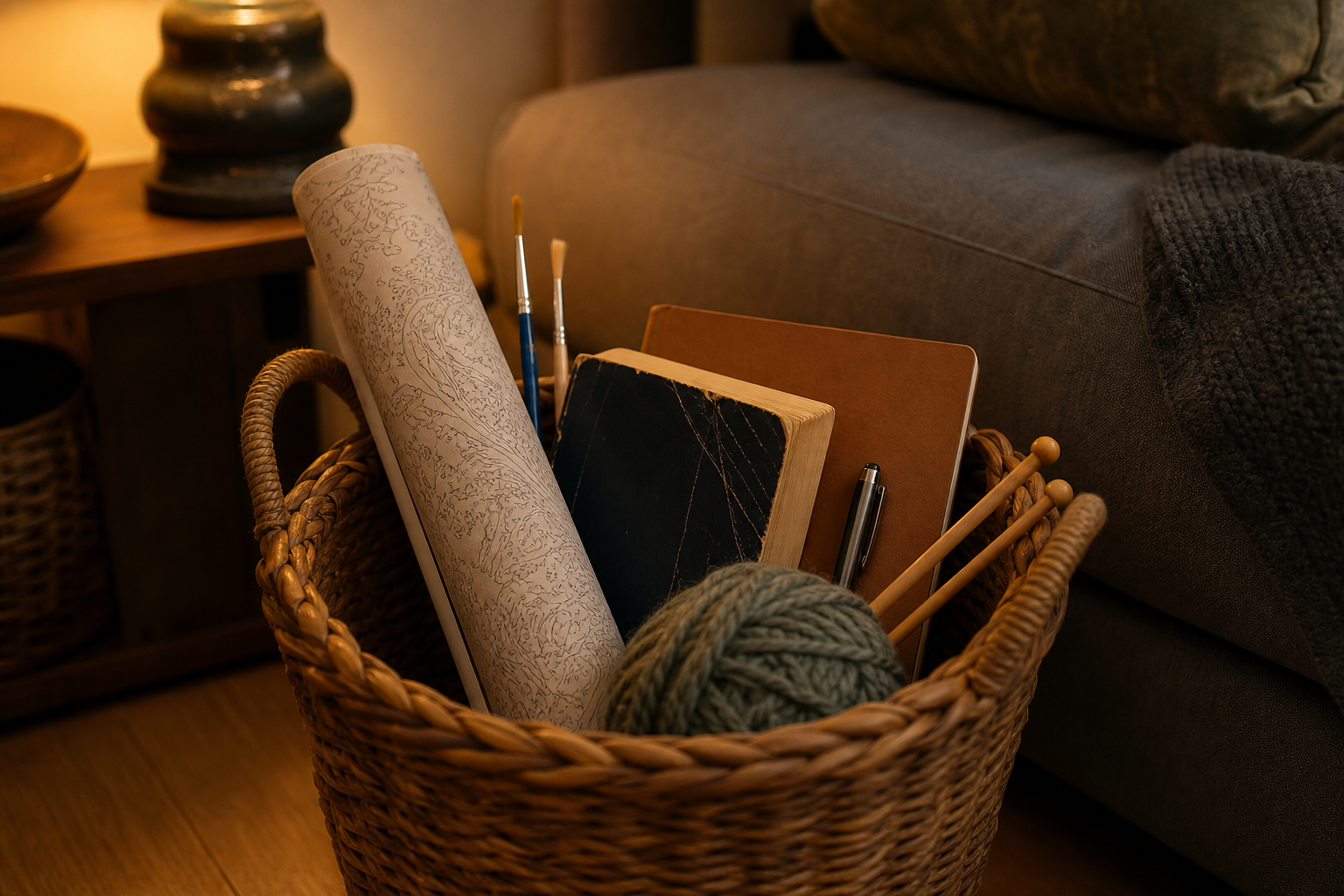
So the practical bit is not the activity, it is the staging. One basket by the sofa or one drawer by the bed, holding the painting kit, the reread, the notebook and a pen that works. Davincified ships each kit rolled in a protective tube with the brushes and paints in the box, which suits this system well: the canvas can live in the basket without creasing, and fewer parts to gather is fewer reasons not to start.
A few questions people ask
Does it matter which activity you pick? Not really. What matters is that it uses your hands, has no deadline attached, and can be stopped mid-way without ruining anything. Is painting late at night not too stimulating? A numbered canvas is closer to colouring than to making art. There is no decision to agonise over, which is what makes it settling rather than energising. How long before it makes a difference? Give it a fortnight of most evenings. A wind-down routine works by repetition, so the first night mostly feels like admin.
We make these kits for a living, and the evenings people describe to us are almost never about painting well, they are about having somewhere to put an hour. None of this is a cure for a genuinely bad night. But it does give the hour before sleep something to be, other than a slow scroll and a growing sense that you should be asleep by now.